
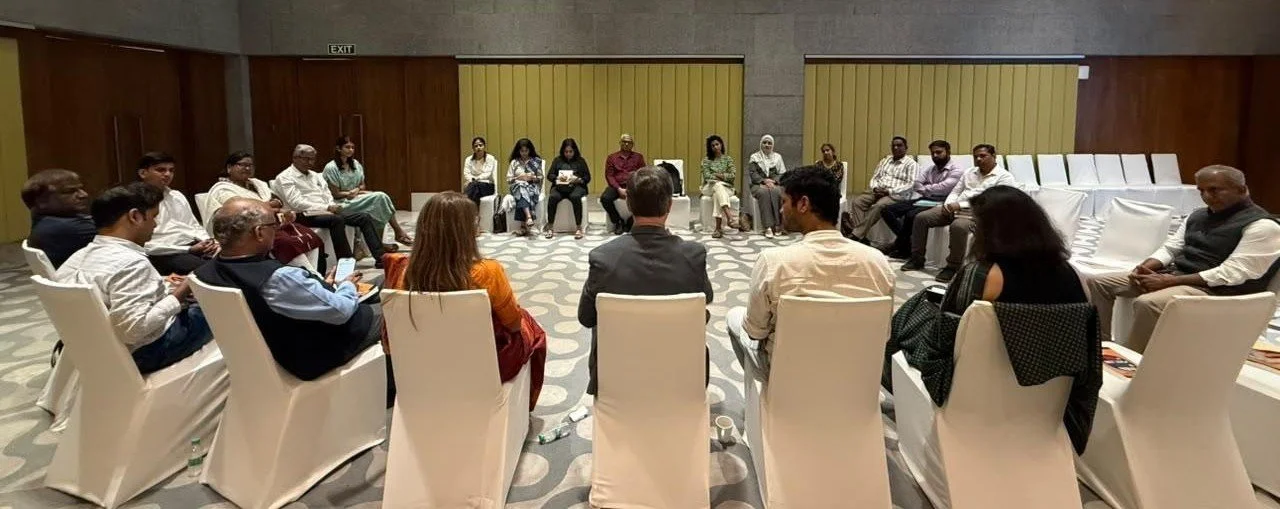
Listening session in Hyderabad, led by Alex Counts and co-hosted by Community Pure Water.
by Alex Counts
Connecting generous donors with exciting impact opportunities is the focus of all good fundraising. When projects are thousands of miles away from where the contributors spend most of their time—as opposed to across town or a short flight away—special considerations arise. Keeping donors and fundraisers informed about client and community needs, important trends, regulatory issues, and unexpected progress, learnings, and setbacks in project implementation is critical, but often challenging, when doing high quality cross-border philanthropy spanning long distances.
As an organization working at the ecosystem level to encourage more, better, and more joyful private giving from the United States to India, being well-informed about how philanthropy can help social sector institutions respond to community and ecological needs is paramount. Towards that end, IPA chairman Jay Sehgal and I held a "listening session" with NGO leaders in Karnataka this past March, with the support of the local office of Akshaya Patra Foundation. The insights that emanated from that gathering can be found here. An unexpected outcome was that NGO leaders in that region enjoyed spending a few hours together, which happened rarely if ever previously; they thanked IPA for convening the meeting.
As part of my just-completed trip to India, I held listening additional sessions in Hyderabad and Kolkata that were co-hosted by Community Pure Water and Pratham USA, respectively. Like the earlier gathering in Bengaluru, deep insights emerged through a process of participants generously sharing lessons learned. Each organization that took part was given 3-5 minutes to describe some lessons learned at the field level that were important, recent, and in some way surprising.
During the same trip, I also took field trips with Community Pure Water in Telangana and with Ek Kadam Aur in West Bengal. Those visits reinforced my belief that Indian NGOs are among the best in the world and that they deserve vastly more resources to expand their impact while setting the standard for the social sector globally.
We are grateful to all the organizations that took part, and to allies such as the Ford Foundation and Myriad USA, which encouraged some of their partners to consider joining. Both sessions were held under Chatham House Rules, where participants including IPA could talk about what was said, but not attribute any point to individual participants without their permission.
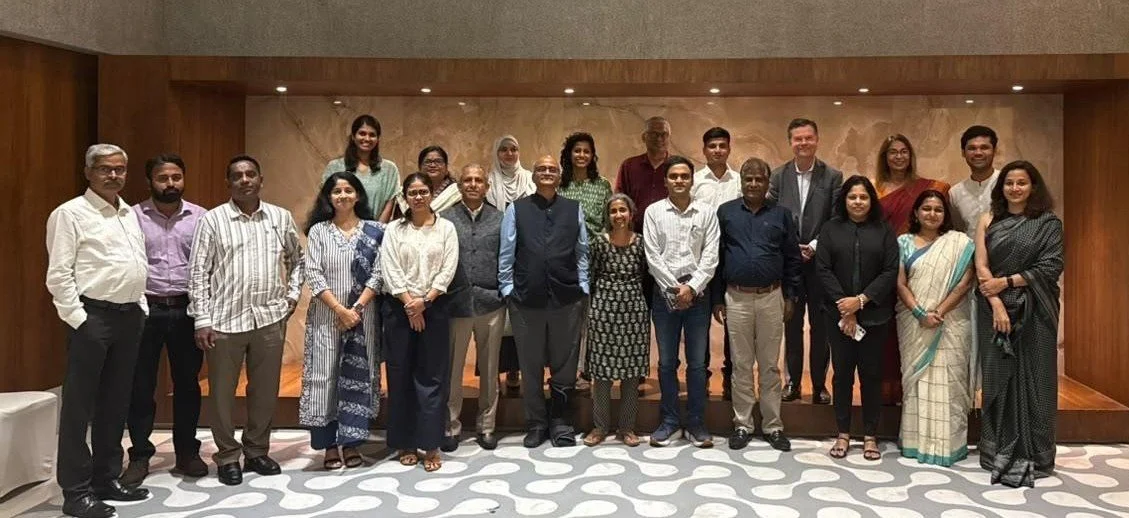
Attendees of the Listening Session in Hyderabad, co-hosted by Community Pure Water
Here are the most important insights that emerged from the listening session in Hyderabad:
1. The tendency to create one-size-fits-all solutions often has limitations and frequently needs to be changed once the reality of field implementation is faced.
2. Social sector organizations need to continuously assess whether, in a development context, they are practicing the values they are preaching. Otherwise, their credibility is at risk in the communities they serve.
3. It can be a wise investment of time to periodically educate young IAS officers about your organization's work, as they are often the ones most open to new ideas. Their influence will grow over time.
4. Echoing one of the points made in the Bengaluru session, one organization said they had consolidated their operations from nearly a dozen states into three. This was not from a budget imperative, but because they wanted to do more work at higher quality in a smaller number of locations.
5. Decentralizing more decision-making to the local level can lead to greater impact. The missed opportunities of not decentralizing decision-making are not always easily apparent, but they are real.
6. Being too reliant on government funding is a significant risk. One organization had been receiving 60% of its revenue from the government, and then faced a retrenchment.
7. Many participants reiterated that meaningful change takes time, and that some stakeholders— including donors, public sector partners, and the media—often underappreciate this truth and are therefore understandably impatient for results. This is especially true when the changes to be achieved are meant to be permanent, rather than transitory.
8. Donors often need education about the causes they give to, such as disaster relief, since the realities on the ground are not always obvious or intuitive, even to highly educated people.
9. When children are given the opportunity to freely speak their minds about development programs, the things they will say will often blow the minds of social sector implementers. They must be given voice.
10. The view that Southern Indian states are more developed than northern ones masks the heterogeneity within both southern and northern India. There is affluence and poverty in both regions.
11. Bringing a gender lens to development planning and implementation is increasingly common, but bringing a caste lens needs more attention.
12. NGOs are largely disconnected from the social movements in India today. This is probably accentuated by the fact that so many NGOs work closely with public sector institutions.
13. A good question to ask when providing services to marginalized people is this: Does this service give them a greater sense of agency?
14. One way to think about sustainability in development programs is the extent to which the initial energy and enthusiasm once a program is launched is able to be sustained after 12-18 months go by.
15. One participant talked about the formation of a working group of NGOs working on youth development, which sounded similar to IPA in its intent to share good practices, present a united front, and grow their industry. It was working well!
16. Succession planning is needed both at the level of key talent (leaders) but also at the organizational level. NGOs need to think about, what will they do when the issue they are currently working on is solved or is entirely taken on by the public sector?
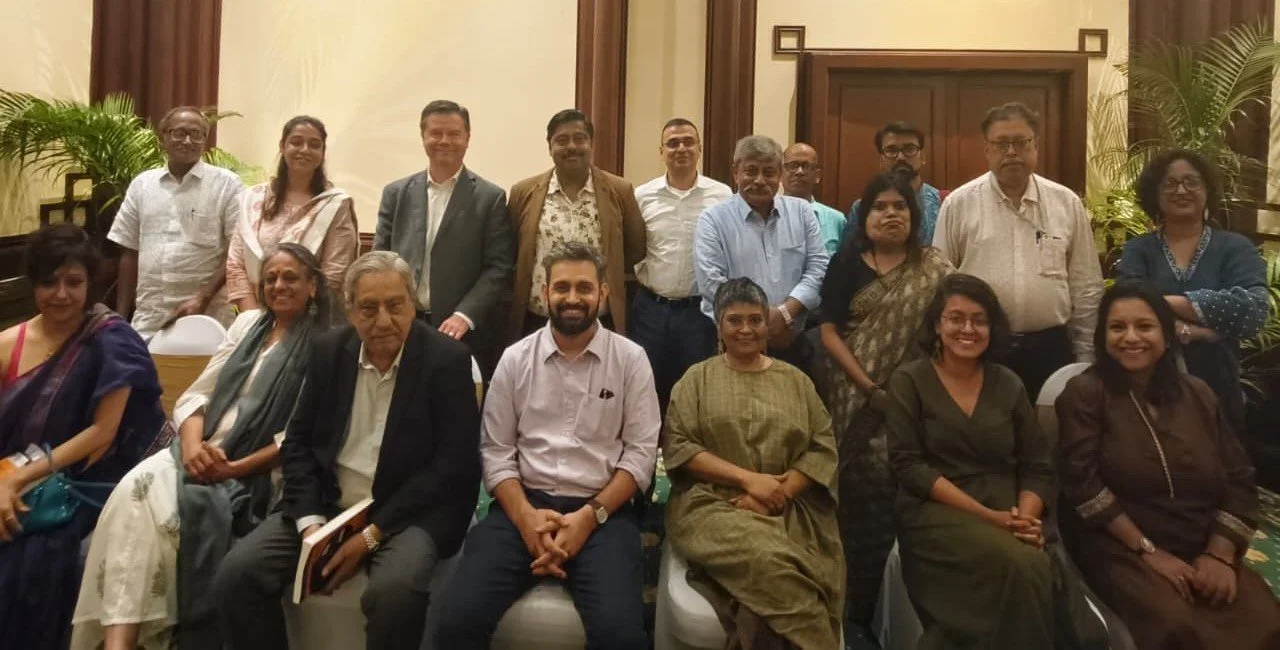
Attendees of the Listening Session in Kolkata, co-hosted by Pratham USA
Key learnings from the Kolkata session were:
1. There is a marked difference in work culture between North and South Bengal. Additionally South Bengal has more practitioners of development than North Bengal, where the necessity is likely more.
2. Too few Bengali philanthropists had stepped forward so far.
3. It is a challenge to work within the government apparatus while retaining flexibility and independence.
4. All NGOs should model the practice of being accessible to employees, clients, and other stakeholders who have disabilities.
5. There is a major structural bottleneck we face on the ground—what was referred to as the "Averaging Out Trap" of West Bengal’s poverty data. While national metrics project West Bengal as having moderate economic prosperity on paper, these macro-averages completely mask severe pockets of chronic poverty across distinct geographies far from Kolkata. Because of this statistical masking, field practitioners across the state face a persistent challenge in securing institutional funding compared to peers working in states that are more broadly labeled as "backward."
6. Flexible, unrestricted funding from abroad allows organizations to work holistically and with a long-term perspective. It is essential.
7. West Bengal does not have a shortage of grassroots social capital or ecological wisdom; it has a shortage of institutional scaffolding. If diaspora philanthropy can champion a Collaborative Hub Model and climate-adaptive resilience, it will transform the developmental landscape of Eastern India.
8. The group noted the critical importance of deeper collaboration among civil society organizations (CSOs). Every NGO brings unique strengths alongside inherent limitations; however, by proactively collaborating, building on one another’s core competencies, and complementing our roles based on ground-level requirements, NGOs can collectively create a transformative wave of impact across the sector.
9. It is important to ask clients and communities fundamental questions every so often, such as, "What does dignity mean to you?" And it is important to listen deeply to what they say.
10. Government agencies understandably often feel they need to do something quickly to respond to pressure from the public or from senior officials. NGOs should attempt to help them whenever possible, even if a slower approach might be ideal. You need to meet the government where it is in a democratic society.
11. Dealing with "floating populations" of migrants within a state like Bengal can be a significant challenge.
12. Defining development program outcomes is challenging, but it is easier when impacted communities are involved in doing so.
13. Always be looking for common ground with government, even if you disagree on some fundamental issues.
14. Climate change is linked to all other social sector issues and cannot be ignored.
15. The best organizations figure out how to partner with multinational companies, universities, and grassroots communities. This is not easy, however!
16. Heritage preservation can be an engine of economic growth.
17. Online safety for vulnerable populations, and others, is a growing issue.
Once again, we appreciate the generosity of time and spirit that all participating organizations brought to these gatherings. We plan to hold listening sessions in other states in the months ahead.
Participants in Hyderabad Listening Session:
1. Ankit Agrawal, Teach For India
2. Niloufer Baig, New Equitable and Innovative Educational Association
3. Anisha Baura, Goonj
4. Shraddha Bhartia, Community Pure Water
5. Nitin Desai, Agastya International Foundation
6. Prasad Gade, Action For India
7. Ravi Ganti, Children's Hope India
8. Sanjay Kadaveru, Action For India
9. Neha Kanitkar, Community Pure Water
10. Ramesh M, Community Pure Water
11. Arpita Mallick, Goonj
12. Asis Mallik, HelpAge India
13. Chaitanya Mrsk, Community Pure Water
14. Anupama Muhuri, CRY- Child Rights and You
15. Sunil Netheti, Teach For India
16. Ravali Pidaparthi, Esther
17. JP Rao, Community Pure Water
18. Radha S, Katalyst
19. Shiva Sharnappa, S M Sehgal Foundation
20. Meera Siva, Inkludo Impact Foundation
21. Lalitha Tirumalareddy, Aarti for Girls
22. Amir Ullah, LedBy Foundation
23. Vishal Vatambe, Rural Development Trust
24. Vanitha Prabhu, VOICE 4 Girls
25. V. Yetendra Yadav, HelpAge India
Participants in the Kolkata Listening Session:
1. Manjusmita Bagchi, Ek Tara
2. Jayanta Basu, Environment Governed Integrated Organisation (EnGIO)
3. Ranajit Bhattacharyya, Pratham USA
4. Sonali Bhattacharya, Prasari
5. Kathakali Biswas, Anjali
6. Dr Swati Chakraborty, Child in Need Institute (CINI)
7. Priyanjali Chakraborty, HelpAge India
8. Subhankar Chakraborty, PRADAN
9. Partha Dey, Association for India's Development
10. Gaurav Dutt, Teach For India
11. G.M. Kapur, INTACH - The Indian National Trust for Art & Cultural Heritage
12. Dolon Ganguly, Azad Foundation
13. Anuradha Lohia, Manovikas Kendra Rehabilitation and Research Institute for the Handicapped
14. Dr Jayanta Munsi, SPADE
15. Indranil Niyogi, Swiss Philanthropy Foundation
16. Madhumita Pyne, Child Rights and You (CRY)
17. Abdur Rafique, Independent Development Professional
18. Ratnaboli Ray, Anjali
19. Vinita Saraf, Ek Tara
20. Neha Singal, Bhumi