
Insights from a Listening Session in Southern India
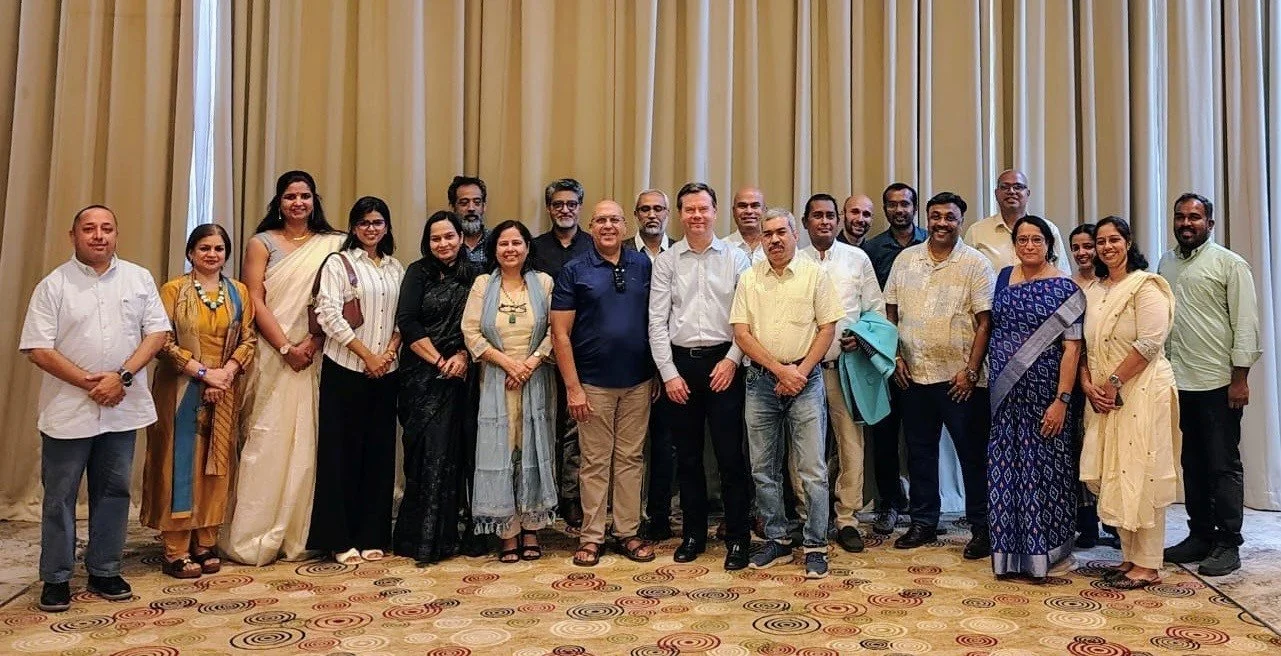
The IPA Listening Session in Bangalore drew 21 development professionals from 15 NGOs in Southern India.
by Alex Counts, Executive Director, IPA
On March 22, 2026, IPA organized a three-hour listening session with regional nonprofit leaders on the eve of the Indiaspora Forum held in Bangalore March 22-25, 2026. The list of attendees is below; IPA's chairman Jay Sehgal and I were the co-hosts. The participants were asked to share a few surprising and/or underappreciated recent insights about doing development work in India today. The most salient points are summarized below, which we believe have relevance far beyond the state of Karnataka.
One participant noted that they had recently reduced the scale of their organizing model from 2,000 to 500 households, and it improved performance/impact.
Another noted that one of their principles was focusing effort on the "last man standing," which is to say the most vulnerable in the community. They noted that doing so requires much effort. This echoed the idea popularized by the development theorist Robert Chambers of "putting the last first."
There was discussion of the power of enabling para-professionals, including para-engineers, in development work. This possibly goes against the trend of emphasizing professionalism in our field.
We learned that due to prohibitions against smoking in public places, many people in India have taken up chewing tobacco, which leads to its own set of health issues.
Many NGOs work with government, but they tend to do it independently. One participant said that might be good if NGOs could approach government together and/or consult more about how to work effectively with government. In this context, I mentioned the paper IPA wrote on good practices on working with government.
We heard that health care and education are the most commercialized sectors in India.
On participant said that starting to work with government can be very hard, but once the work begins, it gets easier.
When seeking to work with government, don't promote your solutions. Instead, try to first understand what problems the government is trying to solve and then suggest solutions that achieve that.
Be open to working with non-traditional and unexpected partners. One group working on getting same language subtitling as part of television and film, so as to improve literacy, made common cause with the deaf community who wanted the same thing for different reasons. And it worked!
The goal in ensuring your solution is sustainable should be to make it so that people forget who initiated the solution in the first place.
One success strategy is to require the people who supervise something, like teaching, to periodically do the job that they supervise.
Education NGOs tend to ignore the needs of those who teach and study in middle school.
When you plan your exit strategy from a village or some other unit of analysis in 3-5 years, make sure it is realistic. Often it takes longer than is expected by implementers and donors.
When working with the public sector, remember to work with government as a whole, not with a single person inside government who may be transferred or replaced.
When trying to recruit professionals, adopt human resource policies that appeal to the younger generation and show them how they can rise on the leadership ladder. Otherwise, they won't join or stay.
In the palliative care sector, Western models don't always apply in India.
Some sectors and interventions don't lend themselves to tangible outcomes; but that does not necessarily make them less important.
Depth models—working intensively with individual clients and groups—can be equally important as those that go for breadth (scale). But the current mindset in development emphasizes scale/breadth too much. We need to argue for the value of both.
In some cases, the equipment in classrooms is up to par, but there is a lack of skilled people who know how to use the equipment.
Perhaps surprisingly, in light of the fact that we often talk a lot about India overtaking China in population, 30 India states have already reached population stabilization, and the other 2 will soon.
Behavior change communications need to be adapted to the way young people think; it needs to take into account their stress levels.
Large complex problems sometimes result from doing or not doing something simple. Also, sometimes complex problems don't require complex solutions.
If you value the uniqueness of your solution or those of others, that might stunt the inclination to collaborate.
Cooperation is not collaboration. Cooperation is helping to scale someone else's solution, or asking them to scale yours. Cooperation is developing a solution together.
Every sector needs a youth strategy.
We need to identify, involve, and recruit new players and new types of professionals, including media houses.
We need more female NGO CEO's outside of the health and education sectors, and on boards of all types of NGOs.
Some of the attendees noted that in convening this meeting, IPA brought together the community of development professionals in Bangalore in a positive way. They further noted that this community would benefit from gathering on a regular basis to exchange perspectives.
Attendee List:
Alex Counts, IPA [Co-Host]
Jay Sehgal, Sehgal Foundation USA (and Chairman, IPA) [Co-host]
Sunish Jauhari, Arogya World
Salome John, Ek Kadam Aur
Sam Kapoor, Sehgal Foundation
Suresh Krishna, Navaka Social Business Fund/Grameen Foundation
Anjali Makhija, SM Sehgal Foundation
Guru Moorthy, Association for India's Development
Soumya Nair, Pratham
Arun Nathan, Sattva
Kshitij Neroorkar, Vibha
Shanmugapriya P., Pallium India
Archana Raaj, Arogya World
Sunil Rachamadugu, Aarti for Girls
Sarika Ramteke, Drishtee
Krishnan Ranganathan, Udhyam
Bijit Roy, One Billion Literates Foundation
Shruchi Singh, SM Sehgal Foundation
Prasid Sreeprakash, PlanetRead
Beeraajaah Sswain, Saloni Heart Foundation
Sudha Upadhyayula, One Billion Literates Foundation
Ebenezer Vidyasagar, Vibha
Manjunath, Pratham