
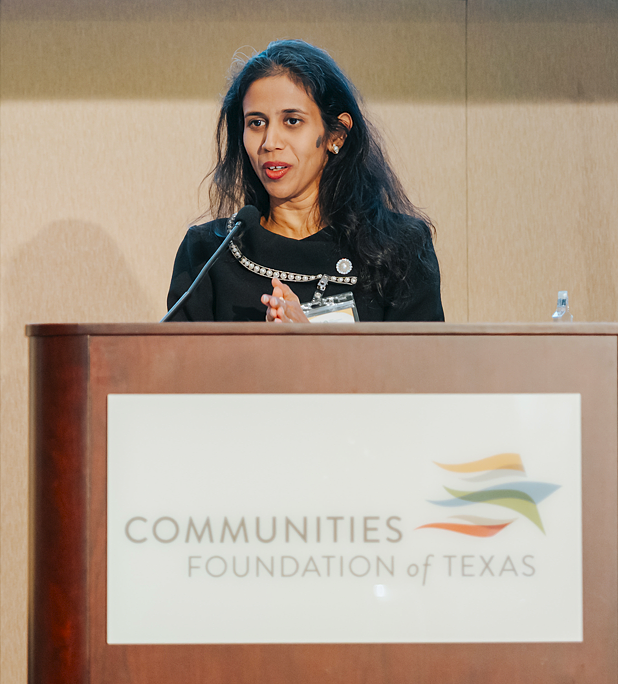
As a way of honoring its founding chairman, Deepak Raj, and recognizing younger philanthropists and social sector leaders, in 2026 the India Philanthropy Alliance launched the Deepak Raj Rising Star Award. The award criteria, promotion, and selection processes were led by IPA's NextGen Task Force composed of the following leaders: Eleanor Elliott-Rude, Arthi Krishna, Shannon Paz, Girish Pendse, Dhirendra Pratap Singh, Jahnavi Singh, Shalina Wadhwani, and Maggie Walsh. In September, IPA announced that Neha Gupta, the Executive Director of Teach for India-U.S., was the inaugural recipient of the award. As part of the award, she was able to direct $10,000 to the nonprofit of her choice, and she was asked to give the closing keynote address at the Indiaspora-IPA Philanthropy Summit. Below is the text of her keynote address, which the attendees found both practical and inspirational; it set a high standard for future recipients. The video of her address, including an introduction by Deepak Raj himself, can be viewed here.
I'm humbled to be the first to receive this award. Especially because it's named after someone who is still very much at work changing the world for the better. I intend to spend the next several years proving worthy of the trust placed with this recognition.
I've been thinking a lot about the term "rising star" since I learned I'd been selected. As a kid, I found it incredible that when you look up at a star at night, you're not seeing the star as it is. You're seeing light that left it years ago, sometimes hundreds of years ago, and has been traveling toward you ever since.
As an adult, it's easier to understand. Because whatever light I have didn't start with me. It came from the people I've been fortunate to cross paths with, and it illuminated my world.
The power of trust-based giving
My first exposure to philanthropy came before I knew the word. I heard about a girl in India who wanted to be a doctor. She wasn't considered exceptional in school, and her family was focused on building her brother's career, so they weren't willing to pay for her coaching for the PMT, the fiercely competitive medical entrance exam. To teenage me, that just seemed unfair. So I asked my parents if we could make it right and pay for her. Being the wonderful people they are, they said yes.
That girl didn't just get into medical college. She came first in her state. Years later, she ranked 17th out of 12,000 in the postgraduate medical exam.
The girl nobody thought was exceptional. All she needed was someone to believe in her.
That moment showed me the power of belief, and gave me what I now have a word for: philanthropy. Or, as I like to call it, investing in social profit because you want to live in a fairer world.
Her light has traveled with me ever since. It led me to Teach For India, which taps India’s brightest to place that same belief in children from India's low-income communities every single day. And today, that light has reached this room.
Tree of Life*
If you haven’t already, please walk by the tree in the lobby. In the morning, it was bare branches. Beautiful, but bare.
Over the course of the day, that trunk has turned into a canopy. I want to use those four leaves as my map for the next few minutes.
From closing the gap to setting the standard
Before we dive in, let's quickly talk about what today asks us for.
The generation before us closed gaps. As an act of love, and an act of courage.
But setting the standard means Indian diaspora philanthropy isn't the thing that catches up to best practice. It is best practice. It means that twenty years from now, when someone in Nairobi or São Paulo or Manila wants to understand how a diaspora can transform the land of its birth and the land of its work, at the same time, they study us.
That's not a small ambition. So let's talk about what it takes.
The Seed: Give like it matters
The green leaf asked: What radical idea are you planting today?
Here's mine. Setting the standard doesn't start with money. It starts with a decision: to treat our giving with the same seriousness we treat our careers.
With strategy, with learning, with ambition, and with the willingness to be wrong and try again.
There's an old saying: Tell me what you value, and I might believe you. Show me your calendar and your bank statement, and I'll show you what you really value.
Our generation has more capacity to give than any generation of Indian Americans before us, and we are not yet giving like it. The upside is enormous.
The gap between what we give and what we could give is the single largest untapped resource for social change in India, and I'd argue in the United States as well.
So the question I ask all my friends and relatives: Have you calculated your number? The amount you realistically need to live a comfortable life for you and your family.
Because once you know your number, you also know something else. Everything else is your capacity to change the world, not just in money but in time and all your skills.
So let’s give ourselves the agency to really ask ourselves: what radical idea would you like to plant if you were free of the hamster wheel?
The Sunlight: No one grows alone
The gold leaf asked: What source of partnership fuels your commitment?
Across the two days [of the Summit], we kept hearing today about bold bets on community impact.
Setting the standard means we stop being individuals who show up with answers and start being partners who show up with curiosity and trust.
We've all heard "trust, but verify." And as I heard someone say in the Myriad session yesterday, our diaspora can learn to verify, then trust.
So let's lean on our community to do the verifying, so we can lead more often with trust. IPA and Indiaspora are great examples of exactly that.
We've already seen what happens when families pool their knowledge, share their due diligence, and co-fund what works.
That's not a dream. It builds infrastructure faster. And as we heard earlier from Rohit Menezes, investing in that infrastructure is one of the highest-leverage things any of us can do.
Sales and infrastructure shouldn’t be reserved for building the next iPhone or AI demigod solution; let’s invest to solve the world’s toughest problems. For social profit. The ROI is much higher.
The Oxygen: Measure what gives life
The orange leaf asked for a single word that describes the breath of life your work brings.
As someone who loves data and spends a lot of time with technology tools, I can't help but make today's debate part of this.
The problem is never measurement. The problem is measuring the wrong things because they're easy to count. As we heard earlier today, outcomes, not outputs.
At Teach For India, I'm often asked: what's the ROI on sponsoring a Teacher for two years? I can share the academic outcomes and the number of children reached. I can share the lifelong multiplier: 70% of our Fellows stay in the social sector. But an independent study by Harvard Business School put it best. The test scores measured what students learned.
Teach For India's real impact was who they became: their agency, their career readiness, their sense of equity, their social and emotional growth. The things that are hardest to quantify.
Setting the standard means we become the community that measures what gives life, not just what fills a spreadsheet. We, donors and civil society, collaborate more closely on defining what that looks like.
We use data as a flashlight, not a judge. And when the numbers and the people disagree, we listen to the people first.
The Thorn: What we must shed
And then there's the red leaf. The thorn. What must we overcome together?
I read a lot of those leaves today. But let me name the one I think runs underneath all of them.
We don't talk about it.
In so many of our families, money is private. Giving is private. We don't ask our parents what they give or why. We don't tell our children. We don't compare notes with our friends. And so every family starts from zero, reinventing the wheel, making the same mistakes in isolation.
Setting the standard means breaking that silence. It means sitting down at the dinner table this Diwali and asking your parents or telling your kids: What do you give to, and why? What do you wish you'd done differently? It means being willing to say, at a Summit like this one: here's what worked for me, and here's what didn't.
Our silence protects our privacy. But it costs us our impact.
Let's be the kind of light that makes it easier for the next generation to shine.
As we saw at our symposium yesterday at the University of Texas at Dallas, the next generation is here. They didn't wait for permission. They didn't wait until they had wealth. They just started.
Every Christmas, I do a challenge for all my nieces and nephews at least 2 years old to pick a cause I'll donate $100 to on their behalf. It forces them to think, to experience, and it places trust, teaching them how to start their journey in philanthropy
I see the same thing at Teach For India. Our 5,800 alumni have started more than 165 organizations, lead more than 80 others as senior executives, shape education policy across 26 states, and work in nearly every major organization in India's education sector. All of it grew out of two years of lived experience alongside the children who needed them.
So here's what I'm asking
I don't want you to leave today with just inspiration. Inspiration fades by Thursday. Even faster if you hit travel delays.
I want you to leave with a commitment. In the next thirty days, do three things:
First, calculate your number. If you already know it, decide what you'll do with everything above it.
There is a great saying in Hindi: Poot Sapoot to kyun dhan Sanchay, Poot Kapoot to kyun dhan Sanchay. The English translation is: Why bequeath wealth to an unworthy child, why bequeath wealth to a worthy child, as they’ll be fine without your wealth anyway.
So, I challenge you to be honest in calculating your number.
Second, have one real conversation about giving. With someone in your family you've never had it with, or with someone you met at this Summit. Not a LinkedIn request. A real conversation.
Third, make one gift that's bolder than the last one you made. Bigger, or riskier, or more trusting. Whatever "bolder" means for you.
That's it. One number, one conversation, one bold gift. If every person in this room does those three things, we will have done more in thirty days than most summits do in thirty years.
The light we send
One day, another young person is going to stand on a stage like this one. Maybe they'll be receiving an award. Maybe they'll just be someone who decided to give. And they're going to try to explain where their light came from.
I hope they talk about us. I hope they say:
This was the generation that broke the scarcity mindset.
They gave boldly, partnered humbly, measured what mattered, and broke the silence. They planted trees whose shade they would never sit in.
The light we send today, from this room, will shine for years to come. So let's make it shine bright.
Thank you for the privilege of learning from all of you over the past two days and for growing together in our journeys ahead.
*The Summit organizers, upon a recommendation by IPA board member Dhirendra Pratap Singh, created an installation called the "Tree of Life: A Living Canopy" where participants could hang leaves where they wrote their aspirations, intentions, and obstacles related to creating a better world. Neha's address described the different colored leaves and what they signified.