
The Accidental Philanthropist: MR Rangaswami on Building the Giving Habit
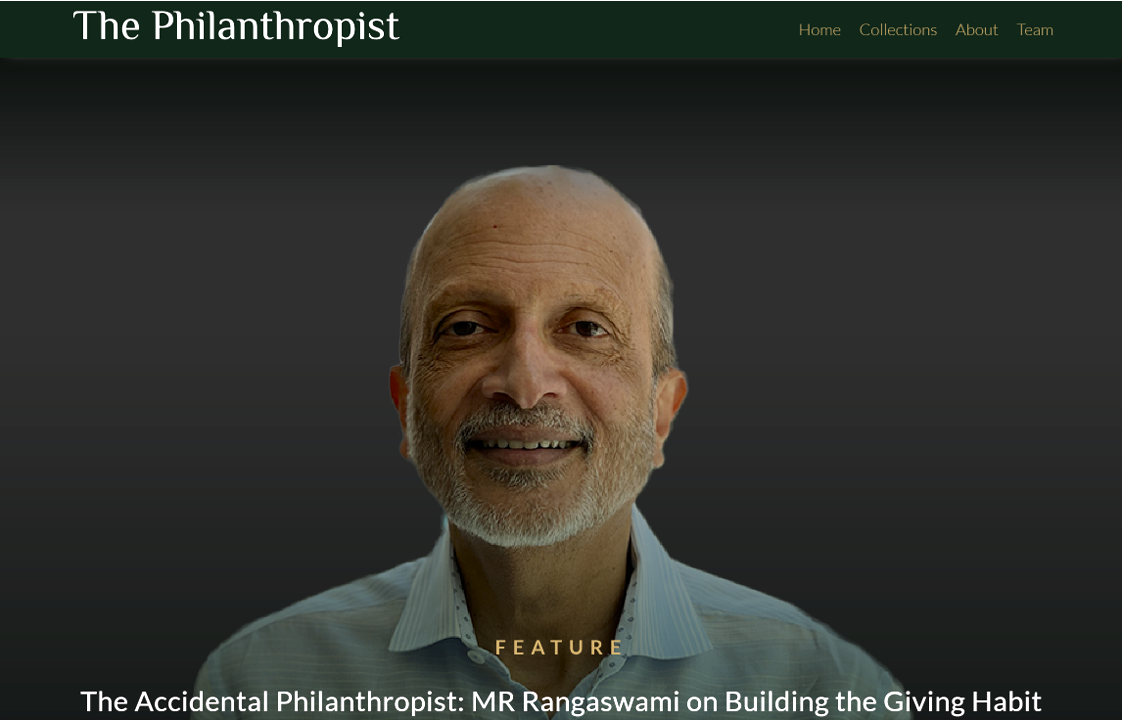
MR Rangaswami is a legendary force for good in the world and in the Indian diaspora, and he has been a strong supporter of the India Philanthropy Alliance since its inception. We are reprinting, with permission that we are grateful to have received, the article below about him that was originally published by The Philanthropist, an initiative of GivingPi and Dasra.
How Indiaspora is Unlocking the Potential of Diaspora Philanthropy in the New Millennium
GivingPi Editorial Team | 28th January 2026
Some lives unfold as metaphors for their time. MR Rangaswami’s story — as a young graduate growing up in Chennai to an up and coming Silicon Valley entrepreneur, sustainability evangelist, investor, community-builder, and eventually one of the most catalytic voices in diaspora philanthropy — mirrors the evolution of a generation that left India in search of opportunity but ultimately found responsibility along the way.
And like many transformative stories, his began almost by accident. It began in 1997, when he convened what he assumed would be a routine gathering of tech CEOs in Silicon Valley. Instead, that room surfaced a much deeper question: What responsibilities accompany success? And what does the tech community owe to the societies it moves through and the homeland it carries within?
This question stayed with MR. Over the next two decades, it grew from a personal instinct to an institutional vision, and has been instrumental in shaping Indiaspora, founded in 2012. The platform was built to channel shared heritage into shared purpose: a network mindset applied to philanthropy, community-building, and systematic impact.
From Enterprise to Ecosystem Thinking
Long before he stepped into philanthropy, MR was already doing something fundamental: he was building ecosystems. As co-founder of Sand Hill Group, he helped nurture Silicon Valley’s emerging angel investor community. Later, he founded the Corporate Eco Forum, a first-of-its-kind space where Fortune 500 leaders examined sustainability as a strategic imperative—years before the ESG framework had been integrated into corporate vocabulary. Across these chapters lies a clear throughline: platform-building appears often at the core of MR’s forays within and outside the sector. The platforms he has built over the years serve as enabling environments where people discover shared purpose, exchange ideas, and deepen trust to collaborate with each other. This also shaped MR’s understanding of philanthropy. Over time, he began to see that giving was not just about individual generosity; it was about mobilizing others. His role, as he came to define it, was not simply to fund initiatives but to bring the right people into the room, create the conditions for alignment, and build structures through which generosity could move more freely.
Building Indiaspora: Purpose, Praxis, and the Bridge of Trust
By the early 2000s, the Indian diaspora had become one of the world’s most influential communities — in business, academia, science, medicine, entrepreneurship, diplomacy, culture, and public service. Yet despite this influence, its giving to India remained surprisingly limited. Only 3–5% of overall diaspora giving found its way back to India. The reasons were familiar: Distance created uncertainty. Complex processes created hesitation. And the absence of clear, trusted channels of engagement made it difficult for many to act on their intent to give.
Many diaspora families were eager to give back to India but found it challenging to navigate a fast-growing and diverse social sector from afar. With physical distance came limited visibility into grassroots work, emerging innovations, and credible avenues for contribution. Philanthropy often waited until retirement, or until “after we have achieved enough.” MR recognized the opportunity to build connective tissue. Indiaspora emerged with a mission to create a space where diaspora leaders across geographies could find credible organizations, transparent giving channels, and a community that made generosity feel safe, meaningful, and strategic. His guiding belief soon shaped Indiaspora’s ethos: “Trust is the most valuable currency in philanthropy.” Strengthening that trust through relationships, knowledge-sharing, and collective purpose became one of its earliest and most enduring contributions.
The Indiaspora Way of Giving
When Indiaspora’s first Forum convened at Mohonk in 2012, 100 Indian American leaders arrived with no expectation that they were launching a movement. They came out of curiosity; they left with purpose. Gradually, it began weaving together leaders who had never been in the same room before: philanthropists, entrepreneurs, artists, public servants, and young next-gen changemakers, with each of them discovering what a connected community could achieve.
Over the years, it has evolved from a US-centric gathering into a truly global community spanning the US, UAE, Canada, Singapore, UK, Australia, and beyond. From being the official diaspora partner during India’s G20 presidency in 2023, to hosting the inaugural Indiaspora Forum for Good in Abu Dhabi in 2025 with 500 leaders from 34 countries, Indiaspora has consistently reimagined what collective impact can look like.
Similarly, the organization’s engagements with institutions, non-partisan by design, demonstrate the constructive role diaspora communities can play in shaping dialogue and cooperation. Today, Indiaspora helps build a language of trust between institutions. This “dual engagement” model positions the diaspora as a bridge-builder, grounded in relationships, shared values, and practical problem-solving across borders.
Over the past decade, Indiaspora has also managed to galvanize philanthropic interest among diverse players and stakeholders, from first-generation founders to young professionals finding their feet across continents. At the heart of this momentum is a simple conviction: philanthropy can evolve into something more formative, when people come together.
A vivid example of this is Indiaspora's part in constituting the India Philanthropy Alliance (IPA), which convenes over 20 leading U.S.-based nonprofits working in India. Alliance helps these organizations think together, plan together, and avoid working in silos, making every philanthropic dollar stretch a little farther. One of its most successful efforts is India Giving Day, launched in 2023 and inspired by the global Giving Tuesday movement. In just its first three years, the initiative has grown from promise to proof: Year 1 raised $1.4 million, Year 2 jumped to $5.5 million, and Year 3 reached an inspiring $9 million. The 2024 edition alone mobilized nearly 1,700 donors and 35 organizations, demonstrating the diaspora’s ability to rally significant capital in a single day when given a shared platform and story to unite around.
Complementing this is IndiasporaNEXT, Indiaspora’s leadership platform that nurtures young Indian-origin leaders and social entrepreneurs. It connects their professional ambition with social responsibility, equipping emerging philanthropists with the tools, networks, and frameworks to engage meaningfully.
Sector leaders observe this shift as part of a broader maturation of the diaspora ecosystem. Dr. Nalini Saligram, founder of Arogya World, and founding circle member of Indiaspora reflected: “What gives me hope about the philanthropy ecosystem today is how intentionally it’s beginning to knit itself together. Indiaspora embodies that spirit, bringing Indians across the world into a shared sense of purpose and possibility. Over the years, it has grown into a powerful backbone for the sector, anchoring efforts like the Philanthropy Summits, diaspora giving surveys, the India Philanthropy Alliance, and now the remarkable Forum for Good.
Initiatives like IPA’s India Giving Day and Dasra’s GivingPi—both of which I am involved in—are further proof that strong ideas can take root when nurtured by a committed community. Together, these efforts become signals for a maturing ecosystem that invites every diaspora member to embrace their responsibility, and give to the best of their ability, thus improving the world we live in.”
MR remains candid about the complexity of this work. “Transparency and collaboration are the hard parts,” he admits. Early experiments revealed that while collective mobilization can be powerful, unstructured giving or duplication of effort can quickly dilute impact. He recalls that building collaboration among nonprofits took nearly two years. “Competition for donor dollars is real, but when they come together, the results are exponential.”
MR is very clear-eyed about philanthropy’s contradictions, particularly the way it can draw strength from the very systems it seeks to change. “Our challenge is to ensure philanthropy doesn’t just reproduce power but redistributes it.” Over the years, he has seen how, without introspection, even well-intentioned efforts can reinforce hierarchies or centralize decision-making. As wealth becomes increasingly concentrated, he believes givers and institutions must examine their own role with more honesty, stay close to community realities, and back approaches that expand access rather than narrow it. For MR, naming this tension is part of the work. It clarifies the opportunity: philanthropy, when practiced with humility and accountability, can help move power closer to the people and communities who must ultimately shape their own futures.
The New Moment for Indian American Philanthropy
Philanthropy among the diaspora has tripled to an estimated $4–5 billion annually, according to a 2025 report by Dalberg, Indiaspora, and the IPA. The once-staggering gap, the difference between potential and actual giving has narrowed from $3 billion to just $1 billion in six years. This transformation reflects not only growing wealth but also a maturing culture of philanthropy. Indian Americans now donate a higher share of their income than the U.S. national average, and they are expected to transfer over $2 trillion in wealth over the next two decades. However, the barriers of transparency and trust still persist, particularly for first-generation donors or younger professionals exploring their philanthropic identity.
This is where Indiaspora’s role has been particularly catalytic. By connecting diaspora donors with vetted organizations in India, facilitating learning sessions, and enabling virtual site visits, the network helps build confidence in cross-border giving.
MR’s philosophy of giving rests on three interlocking ideas: start early, lead by example, and make giving accessible. He urges younger generations to cultivate giving as a habit, much like saving or investing, so it compounds over time, especially when nurtured in community. “Once you start, it becomes part of who you are.” MR advocates embedding giving in life’s early milestones: setting aside a percentage of startup equity, committing time each month to nonprofit work, or involving children in volunteer activities. Avanish Sahai, philanthropist and member of Indiaspora, notes “...throughout this time, MR’s ability to quickly focus on making an impact, minimizing egos, and removing obstacles has been exemplary. He often discusses "how to help others" as a measure of actual success and realization in life.”
Philanthropy must feel accessible as much to the nonprofits as also for the givers themselves. Enabling this must begin with a strategic overhaul: lowering the barriers to entry, making information transparent, bridging trust gaps, or even creating collective platforms that allow first-time donors to participate confidently. “Your giving becomes a signal to others. If you allocate stock upfront for nonprofits, or commit a steady percentage annually, you normalize giving as a practice.”
Over 25 years, his original tech CEO community called Enterprise has generated over $2.5 million in direct giving and mobilized more than $25 million indirectly. As India looks toward 2047, MR believes diaspora engagement can play an important role which extends far beyond remittances or investments. “India’s transformation depends on aligning the financial, intellectual, and social capital from diaspora with the country’s structural priorities: education, climate, child protection, innovation.”
The Diaspora Ways of Belonging
The coming decades could mark a shift in how giving is practiced—less episodic, more embedded in daily life and professional choices. By 2047, MR hopes to see philanthropy woven into careers, startups, and household financial planning, supported by transparent and collaborative giving platforms. This is already taking shape across Indiaspora’s network, where donors increasingly see themselves as contributors to India’s long-term development story.
MR was candid about his own journey. He described his giving as evolving, sometimes improvised, and acknowledged that engaging the next generation requires patience and openness. “The next generation will define giving in ways we can’t fully predict,” he said. “Our responsibility is to equip them with tools and trust, not strict templates.”
As diaspora philanthropy enters a new phase, the emphasis is shifting from individual generosity to shared purpose. The momentum building today has the potential to redefine not just how Indian Americans give, but how they imagine their relationship with India itself. In that reimagining lies the real promise of the next decade: a community confident in its roots, global in its reach, and united in shaping India’s future.