
What Happens When You Put Students in the Grantmaker's Chair
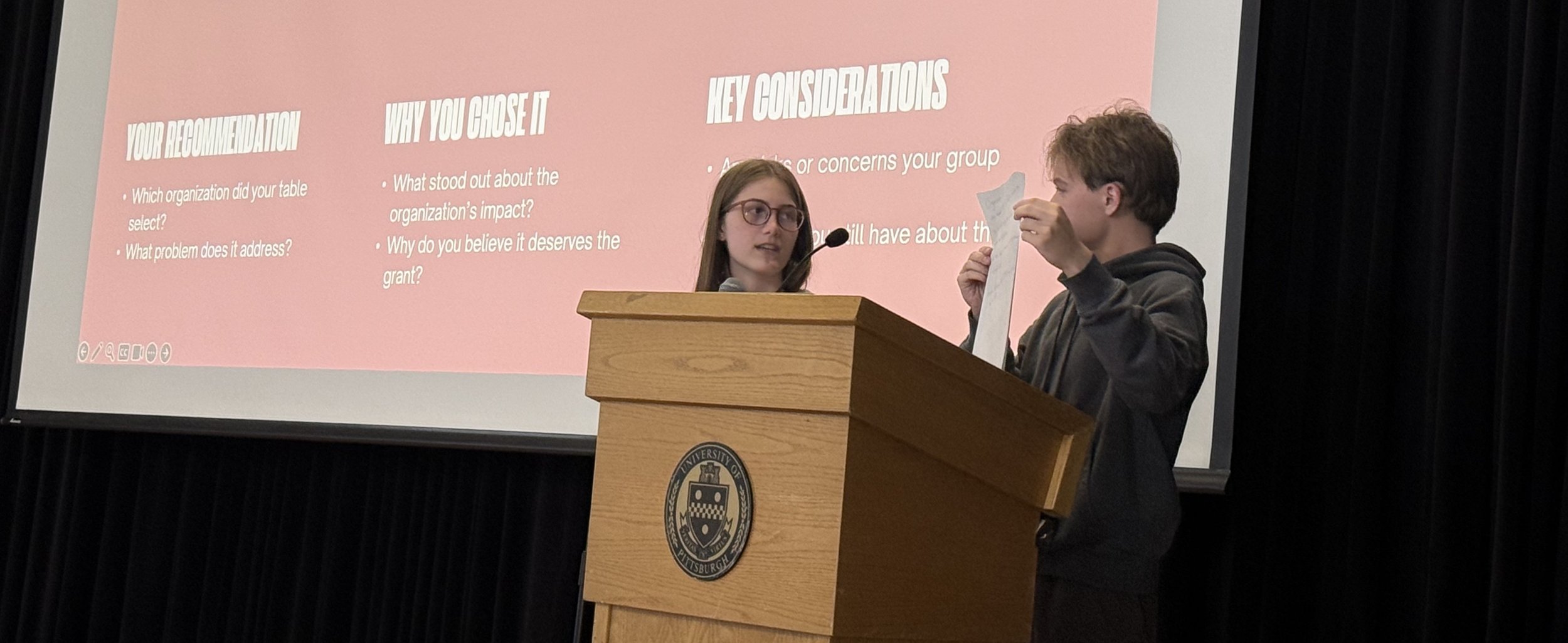
Students at the University of Pittsburgh share their recommendations for who to receive a $15,000 grant from TechLeap India as part of an India Giving Day exercise.
By Ishaan Tilva, Executive Director, TechLeap India
For most of my life, I have cared about poverty in India without having any real idea what to do about it. I grew up in a stable, fortunate household with no shortage of opportunity, and that was never lost on me. On a trip to India, I visited a school, though calling it that was a stretch, and met children who were brilliant, full of life, and curious about everything. They reminded me of myself. The only difference between us was where we were born, and that difference meant they would likely never get the opportunities I had been handed. I knew I wanted to do something about that, but when I looked for ways to actually get involved, the options felt limited. Fundraise. Volunteer. Write a check when you’re older. None of it answered the question I kept coming back to: how do you actually change lives as a teenager?
I held that frustration for years before doing anything about it. And I am fairly sure I am not the only young person in this community who has felt the same way.
The India Philanthropy Alliance has identified next-generation engagement as essential to sustaining the growth of Indian American philanthropy, and a recent study by Dalberg, Indiaspora, and IPA shows why: diaspora giving has reached an estimated $4 to $5 billion annually, but the question of who carries that momentum forward remains unresolved.
That is the problem we set out to explore with Students as Grantmakers, a program we hosted at the University of Pittsburgh on March 24, 2026, in connection with India Giving Day.
What We Actually Did
We invited nearly 50 undergraduate students to evaluate two education-focused nonprofits under consideration for TechLeap India's next grant, a $15,000 restricted program grant to fund a specific initiative within one of them. One organization focuses on technology-enabled skills training for underprivileged youth; the other invests in early-career teacher development within government schools. Students received condensed evaluation materials, worked in small groups to deliberate, presented recommendations on stage, and cast a live closing vote. We made clear from the outset that their input would play a meaningful role in shaping which organization receives the grant.
What I Didn’t Expect
I walked in expecting surface-level evaluation. These students were seeing the material for the first time and had likely never done this sort of work before.
What happened instead was that students were not just comparing programs; they were thinking at the portfolio level by strategizing how best to complement our initial grant. Several groups noted that since our first grant funded direct scholarships for 15 young women our second grant should complement that approach rather than duplicate it and prioritize broader systemic reach over concentrated impact. "We kept coming back to the idea that a teacher training model could reach hundreds of students through a single cohort of fellows, and that felt like the right complement," said Chad Sciore, a student attendee.
Other groups challenged whether technology-based skilling programs could realistically scale in rural India, questioning infrastructure access in the communities these organizations serve. When the vote came in, five of six tables recommended the teacher development organization, with remarkably consistent reasoning: invest in the layer of the system that multiplies impact over time.
But the moment that stuck with me most had nothing to do with strategy. At several tables, students realized that the organizations operate in the same states their families come from, in Rajasthan, in Gujarat. You could feel it shift from an exercise into something heavier, the realization that they were deciding whose lives to change and whose to walk past. They were talking about the places their parents grew up in, the streets their grandparents still walk, the problems they had seen on trips to India but had never known how to do anything about. That weight stayed with many of them.
"Before tonight, I honestly didn't know anything about how philanthropy in India actually works," said Jose DeSantiago. "This was the first time I really understood what it means to evaluate where money goes and why it matters."
India Giving Day and the India Philanthropy Alliance's support made this evening possible.
What Comes Next
There is no reason this model has to be limited to a single university or organization. The core idea, bringing students into real decisions with real consequences, could work across the IPA ecosystem. The specific format matters less than the principle: that young people engage most deeply when the stakes are real, and their input is valued.
While there is no single answer to engaging young people more effectively in philanthropy, one approach worth exploring further is giving students a seat at the table where decisions are made. On March 24, fifty students at the University of Pittsburgh proved they could rise to the occasion.
TechLeap India is a strategic grantmaking organization that identifies and funds locally-led education initiatives combating systemic poverty in India. Learn more at techleapindia.org