
IPA's Chairman Pays Tribute to the Founder of Akshaya Patra Foundation
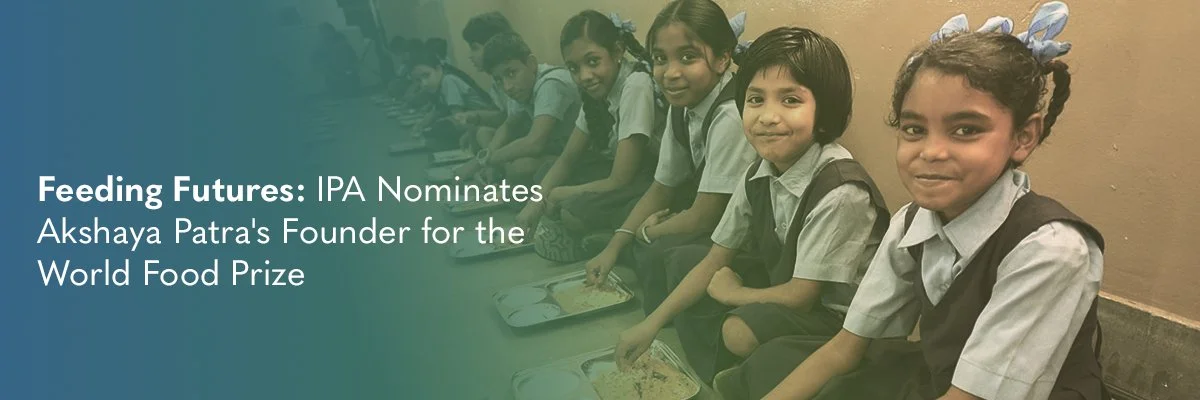
One of the hallmarks of the India Philanthropy Alliance is fostering the community of India-focused nonprofits in the United States with a deep sense of solidarity and camaraderie. We believe that all of these organizations are on the same team, even if they compete in some domains. Few things illustrate this better than a letter recently written by our chairman, Jay Sehgal, in support of IPA's nomination of Madhu Pandit Dasa, Founder and Chairman of the Akshaya Patra Foundation, for the World Food Prize. The World Food Prize is an international award recognizing the accomplishments of individuals who have advanced human development by improving the quality, quantity, or availability of food. The World Food Prize includes a $500,000 grant and is formally presented at the Laureate Award Ceremony annually in mid-October, on or around World Food Day, in conjunction with the Borlaug Dialogue international symposium in Des Moines, Iowa. The India Philanthropy Alliance feels that Akshaya Patra has developed one of the world's most impressive and effective programs for combating food insecurity among schoolchildren. Jay Sehgal is also the Executive Vice President of the Sehgal Foundation and Chairperson of S M Sehgal Foundation in India, which supports impressive work in agriculture, water management, the transformation of rural schools, and women's empowerment. The following is an essay adapted from Jay's letter of nomination.
Under Madhu Pandit Dasa’s visionary leadership, the Akshaya Patra Foundation has built one of the largest and most impactful school feeding programs in the world, addressing hunger and education simultaneously at an unprecedented scale. What distinguishes this work is not only its magnitude—more than 5 billion meals served to children across India—but the systemic transformation it has enabled in public service delivery, nutrition access, and educational outcomes.
In 2001, the Supreme Court of India mandated cooked midday meals as a right for all schoolchildren. While visionary in intent, such mandates often struggle in execution due to logistical, financial, and governance constraints. It is here that Akshaya Patra emerged as a critical implementation partner, transforming a legal entitlement into a reliable, daily reality for millions of children. Through innovative public-private partnership models, advanced centralized kitchen infrastructure, and rigorous quality systems, the Foundation has ensured that meals are delivered consistently, safely, and at scale.
What sets Akshaya Patra apart is its holistic and systems-driven approach. The Foundation has pioneered technology-enabled, high-efficiency kitchens, supply chain optimization, and data-driven operations that have become global benchmarks in large-scale feeding programs. Its model demonstrates how operational excellence, transparency, and mission-driven leadership can dramatically amplify the impact of government programs.
From our direct experience at S M Sehgal Foundation, working across rural schools in 13 states, we have repeatedly seen how the midday meal program—enabled so effectively by Akshaya Patra—serves as a powerful catalyst for educational inclusion. Improved attendance, reduced dropout rates, and enhanced classroom engagement are consistently linked to the assurance of a nutritious daily meal. In many communities, this meal is the primary source of nutrition for children, making it indispensable not only for education but for child development and long-term human capital formation.
Our own interventions—improving school infrastructure, water access, and sanitation—are significantly strengthened by the presence of a reliable meal program. Together, these efforts create an ecosystem where children can learn, stay in school, and thrive. Akshaya Patra’s work is thus not limited to feeding children; it is breaking the intergenerational cycle of poverty and hunger.
Madhu Pandit Dasa’s leadership has been instrumental in scaling this vision with integrity, innovation, and unwavering commitment to service. He has demonstrated how values-driven leadership can translate into world-class operational excellence and measurable social impact. His work has not only transformed millions of lives in India but has also provided a replicable model for global hunger alleviation efforts.
For its scale, sustainability, innovation, and profound human impact, I strongly believe that Madhu Pandit Dasa’s leadership of the Akshaya Patra Foundation represents the very spirit of the World Food Prize. He has made extraordinary contributions to advancing food security and human dignity that deserve recognition.